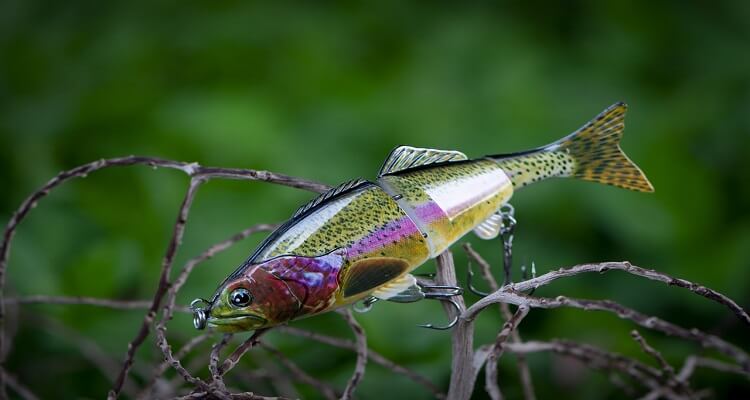
How to fish with lures? A fishing lure is an artificial fishing bait which is used to attract fish attention for catching. Many lures are equipped with one or more hooks that are used to catch fish when they strike the lure. Some lures are placed to attract fish so a spear can be impaled into the fish or so the fish can be captured by hand. Most lures are connected to a fishing line at the end and have different styles of hooks attached to its body and are designed to elicit a strike resulting in a hookset.
Types of lure include:
- Spinner bait
- Swim bait
- Fish Decoy
- Combined lures
- Plugs
- Artificial Flies
- Soft plastic baits
- Jigs
- Spoon lures
- Kabura lures
Using a Lure
Not only is lure fishing insanely effective, but it’s also clean and easy, with no mucking around anchoring, berleying, or dealing with smelly or frozen bait and its waste.
Select a suitable and effective type and color of lure you want, fix it to your hook. It is important to prevent the hook selection from impairing the lure’s running properties. Lures with oblique heads usually have aggressive running features and are very sensitive to the way they are rigged, so if you don’t want to fish exclusively with single-hook rigs I would recommend attaching double hooks (the hook facing the head of a so-called J-hook pattern and the rear one a southern tuna hook pattern) and rig them at an angle of 180°.
How to fish With a kabura lure:
Drop them to the bottom and VERY slowly wind up a few meters. When you get a nibble DON’T strike, just keep slowly winding and let the fish hook itself, striking usually pulls the lure out of a fish’s mouth prematurely.
How to fish with slow jigs
This involves a special technique, depending on lure design, but essentially the lure is deployed overboard and makes its way to the bottom with a great amount of movement.
Make sure your line is fastened to the solid ring of the swinging assist hooks, this makes the lure act like an underwater kite darting and shimmering around like a panicked or injured baitfish.
Give a gentle winding, lift and down, to give an action of life to the lure making it more irresistible and make the fish that have followed it down grab it immediately as soon as it reaches the bottom.
The specialist rods make a big difference imparting the correct dynamic of lift and flick but the fish can’t catch these lures until they stop, so stop them and make a lift, drop, stop – pause, lift, drop, stop-pause and boom! they hook up.
The cigar-shaped lures can be worked more aggressively than the flatter leaf versions, which tend to spin if you give them too much lift. Don’t be afraid to leave them hanging, fish are lazy and the water movement around the lure is often enough to induce a take. When these lures start firing in a hot bite, you will often connect almost immediately every drop, so barbless hooks are a good option for easy release.
How to fish with Soft plastic baits lures
Drop it quietly into a likely drift that takes you across a good ground, casting it ahead in the direction you are drifting. Engage the bail arm and allow your lure to proceed its path the bottom staying in touch and feeling your line in case it toughens. At times fishes smash the lure and go, and sometimes they will try eating the lure for a while, so let your rod tip bend over nicely, take a little weight on then strike. Soft plastic baits often work really well just tickled along the seafloor directly under your drifting boat.
Ideal spots to soft plastic bait lures are where rocks or weed lines turn to sand, where there is a fish sign on the sounder over sand, in channels where the current is running, or when it is any change of light situation inshore. Fish the lightest jig head you can cast and manage to stay in touch with, ¼ oz to ½ oz the most popular.
How to fish with a Spoon Lure
The most important thing is to have a truly excellent drag system. casts the spoon out, lets it fall for a bit, then rips it back like a jerk bait. A spoon falls quickly – about a foot a second – so you simply count it down until it is close to the bottom, then begins retrieving it. Closes the bail, and shoves the rod forward about a foot, then rip it up almost straight up, take up the slack, then rips it again. Do a lot of vertical jigging and pause in between, the fish often take the bait on the fall during the little pause. You can lower the rod and shoves it forward before swinging up on it again.
The sunshine plays a big part in how well a spoon works because the sunlight is what gives a spoon its flash, so on a bright day in relatively clear water, a spoon is hard to beat. If you get a really good spoon bite he can catch a hundred fish a day.
Conclusion
Fishing lures are made of different materials such as wood, rubber metal, etc. But irrespective of the material of your lure, it is expected of you to always keep the hook of your lure as dry as possible when not in use to prevent rusting.
Related Resources:

Stevens is a professional fisherman and he likes fishing! He has been fishing for a long time and he loves using fishing accessories outing as well.


